
Growing Into Independence in Denmark
If you're raising children in Denmark, you may eventually notice something that feels surprisingly different from home:
Danish children seem to do an awful lot by themselves.
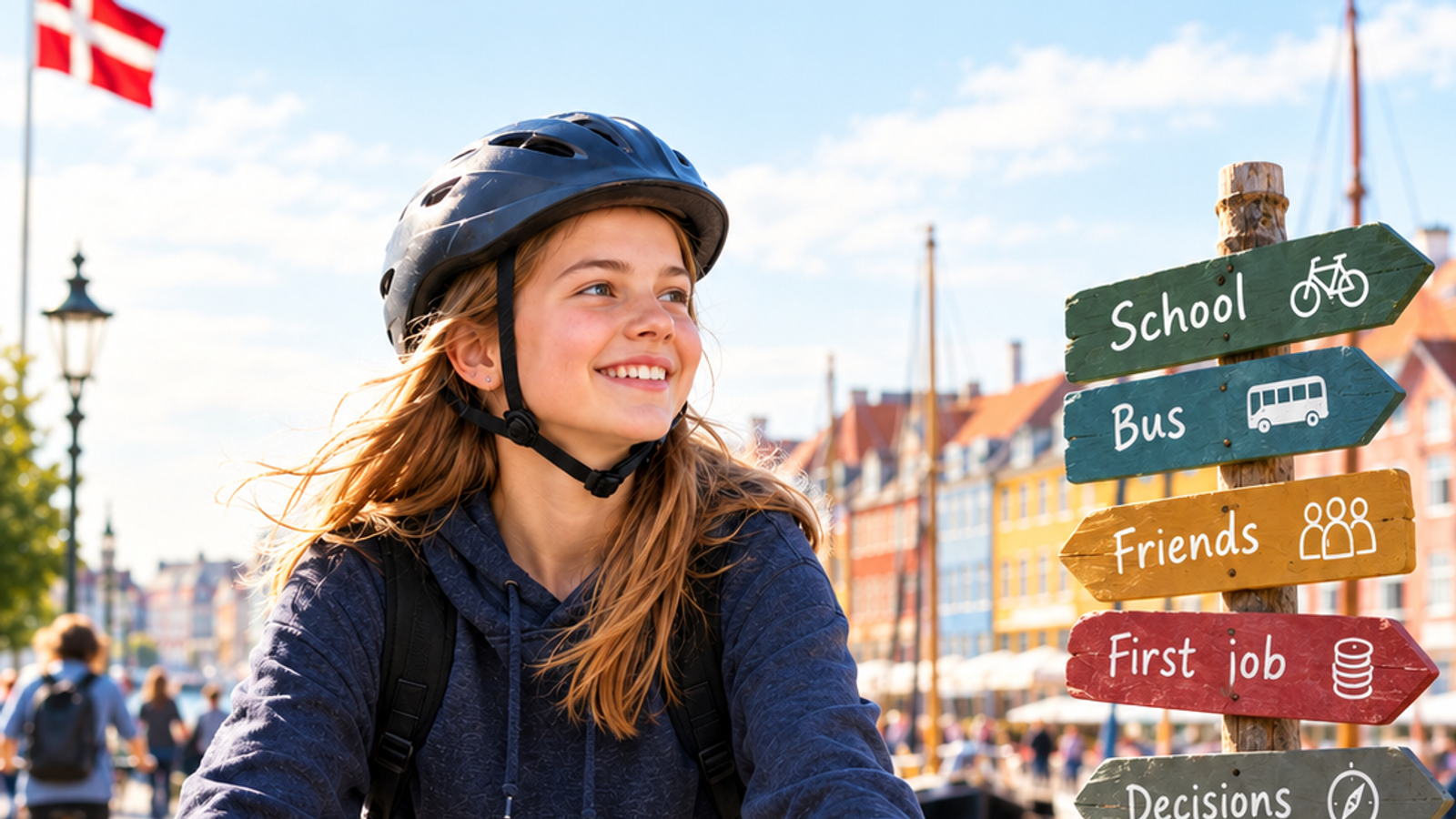
They cycle to school, make their own way home, get themselves to sports and meet friends without a parent organising every journey.
As they grow older, the responsibilities grow too. Public transport. Time at home alone. An after-school job (fritidsjob). Their own money, plans and commitments.
For many Danish families, none of this feels particularly remarkable.
For an international parent, it just might.
And there is some evidence behind that impression. International research into children’s independent mobility places Denmark among a group of countries where children enjoy comparatively high levels of freedom to get around without adults.
Having lived in both Denmark and the UK, what struck me wasn't simply the amount of freedom Danish children seemed to have. It was how differently the journey towards independence could feel.
Not a milestone, but a learning curve
My personal experience in the UK was often of children being carefully protected for longer and then, at 18, something rather significant happened:
They were adults.
Of course, that doesn't describe every British family. But returning to Denmark made me notice the learning curve in between.
Here, independence often seems less like crossing a line and more like a gradual process.
First, perhaps, cycling to school. Then remembering your own key, being home alone for a while, taking the bus or getting yourself to sport.
And sometimes getting it wrong.
You miss the bus. Forget something. Misjudge how long something will take. And have to work out what to do next.
The safety net is still there. Mum or Dad hasn't disappeared. But perhaps they haven't stepped in before you've had the chance to solve the problem yourself.
Sometimes the child isn't quite ready for the next step.
And sometimes it is Mum or Dad who isn't quite ready.
Then you adjust.
The goal isn't to remove the safety net. It is to make it slightly less necessary each time.
When responsibility gets real
By the teenage years, some of those small freedoms begin to carry more weight.
From the age of 13, young people in Denmark can take certain types of after-school jobs (fritidsjob). Suddenly someone other than a parent or teacher expects you to turn up, do your job and take responsibility.
And then there is the Danish residential school (efterskole).
International families sometimes hear it described as boarding school, but the comparison can be misleading. Denmark has boarding schools (kostskoler) too, which are closer to the British or international understanding of the term.
A Danish residential school is something different. It combines education and residential life with a strong emphasis on community and personal development.
For a teenager, school friends suddenly become the people you live your everyday life with.
You have breakfast together, spend your evenings together, laugh, disagree and still have to sit across from each other at breakfast the next morning.
Mum and Dad are still there, just not in the next room to solve every small problem as it happens.
There are adults, rules and support.
But there is also room to find out:
Can I do this?
For many young people, it can be a year to grow and discover a little more about who they are when their family isn't right beside them.
Then the choices get harder
Independence is relatively easy to embrace when we're talking about bicycles, buses, first jobs and forgotten football boots.
It gets more complicated when the decisions get bigger.
Parties. Relationships. Alcohol.
For international parents, Danish youth drinking culture can be particularly confronting. Danish teenagers continue to stand out in European surveys for relatively high levels of alcohol consumption, so if teenage parties feel noticeably different from home, you probably aren't imagining it.
But perhaps the bigger adjustment is realising that your child is adapting to Denmark too.
They are making Danish friends and encountering expectations and social norms that may be quite different from those you grew up with.
And suddenly independence has become something more than getting yourself from A to B.
It has become judgement.
This is where all those smaller steps start to look a little different.
The missed bus. The forgotten key. The first payslip. The disagreement that had to be resolved without Mum or Dad stepping in.
Perhaps they were never really about the bus, the key or the money.
They were about learning what to do when you're the one who has to decide what happens next.
Growing into independence
There is no single Danish way to raise a child.
Children are different. Families are different. The right amount of freedom at the right time will never look exactly the same for everyone.
But living in another country can challenge things we had previously assumed were simply normal.
And living between Denmark and the UK has made me think differently about independence.
Perhaps it isn't something that arrives with a particular birthday.
Perhaps it is something you grow into.
A little freedom.
A little responsibility.
An occasional mistake.
Another try.
And gradually, less need for someone else to steady the handlebars.
Maybe that's the interesting part of the Danish experience. Not whether children have more freedom, but whether there is value in letting them discover what they can manage before they absolutely have to manage it on their own.
And perhaps that's what the “Wait a Minute!” is really about.
Not “Stop.”
Not necessarily “You're not ready.”
Just a pause while child and parent catch up with the next step.
Until eventually, both are ready for:
Ready. Set. Go.
Finding your family's feet in Denmark
Some of the biggest adjustments to life in a new country are the things nobody thinks to explain.
The unwritten expectations. The cultural differences. The moments when something completely ordinary to a Danish family leaves you wondering whether you've missed a memo.
At Simply Settled DK, I help international families understand and navigate both the practical and cultural sides of life in Denmark, so you can find what works for your family.
Because settling in isn't about doing everything the Danish way.
It's about understanding the country your family now calls home well enough to find your own way within it.