
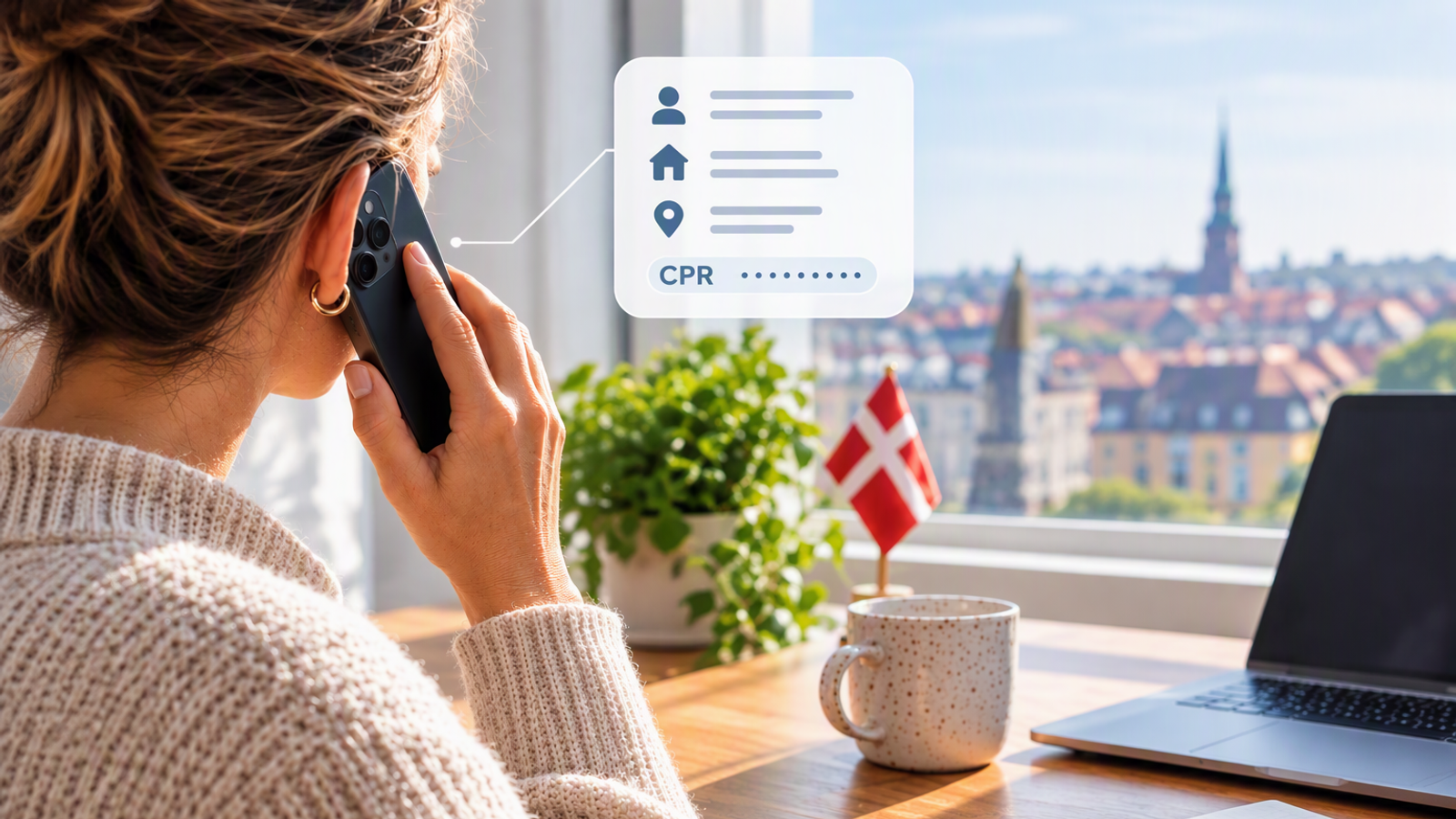
Trust is part of living in Denmark. So is knowing when to pause.
Denmark is built on trust.
Trust in other people. Trust in public institutions. Trust that, for the most part, the systems around us work as they should.
For many internationals, that can be one of the rather refreshing things about living here.
But even in a high-trust society, knowing who to trust matters.
And the recent news about unauthorised access to CPR information is a timely reminder of exactly that.
Getting a CPR number is one of those significant moments when moving to Denmark.
It opens the door to much of everyday Danish life. Banking, healthcare, employment, public services and countless practicalities suddenly become connected to those ten digits.
And before long, sharing your CPR number in the right circumstances can feel surprisingly ordinary.
Which raises a good question:
How much do we actually know about protecting our identity in a country whose systems we are still learning?
“But they knew my CPR number…”
Imagine receiving a phone call.
The caller knows your full name. Your address. Perhaps your CPR number.
There is apparently a problem with your bank account, your Digital Post, an invoice or something else that sounds entirely plausible.
Would the fact that they know those details make you trust them?
For many of us, probably a little.
And that is where this becomes particularly relevant for internationals.
When you are new to Denmark, you may not yet know exactly how your bank usually communicates with you. Or your municipality. Or the tax authorities. Or your energy provider.
Which requests are normal?
Which information would they already have?
Would they call about this?
Should this have arrived through Digital Post?
It takes time to develop that instinct.
Someone who has lived within the Danish system for years may immediately think,“That doesn't sound right.”
A newcomer may simply think,“Perhaps this is how they do it in Denmark.”
And that small difference matters.
Personal information is not proof of identity
Perhaps one of the most important things to take from the current situation is this:
Someone knowing information about you does not prove that they are who they say they are.
A name, address or CPR number can make a conversation sound convincing.
That doesn't make the person at the other end trustworthy.
And there is an important distinction between someone possessing information about you and you giving someone the means to act as you.
Your MitID details, passwords, one-time codes and card information belong firmly on your side of that line.
That distinction is probably more valuable than trying to memorise a long list of things scammers might or might not do.
Because the methods will change.
The principle doesn't.
Denmark actually gives you some choices
But protecting your information in Denmark isn't necessarily limited to spotting suspicious calls and messages. There are also choices built into the Danish system that many newcomers may never have heard of.
One is a credit warning (“kreditadvarsel”), which you can choose to have registered against your CPR number. It signals to businesses that they should take extra care when checking someone's identity before providing a loan or credit in your name.
And no, this is not the same as being registered with RKI.
RKI is associated with unpaid debts and a history of missed payments. You may even hear Danes refer to“Ribers”, the older name that has stuck in everyday language.
The distinction is important:
A credit warning is something you choose as a protective measure. An RKI registration is not.
Then there is name and address protection (“navne- og adressebeskyttelse”). Broadly speaking, this limits who can obtain your name and address from the CPR register.
That is different again from protection from direct marketing (“Robinsonlisten”).
The Robinson List is about opting out of certain types of direct marketing. It isn't general protection of your name and address.
And the slightly odd name? Think Robinson Crusoe, alone on his island and, importantly here, left undisturbed.
Different registrations. Different purposes. And if you are new to Denmark, how would you know the difference?
This isn't a checklist of protections everyone in Denmark needs.
It is a reminder that options exist, and that knowing they exist is part of learning how the Danish system works.
After all, it is difficult to make an informed choice about something you have never been told about.
There is more to knowing the system than knowing how to use it
This is where the story becomes about more than cybersecurity.
Moving to Denmark involves learning a new set of systems remarkably quickly.
You get a CPR number. MitID starts working. Your bank account is opened. The yellow health card arrives. If you have children, their registrations fall into place too.
Before long, you know how to use much of the Danish system.
Understanding its habits, expectations and unwritten rules takes longer.
It is knowing what a normal request from a Danish authority looks like. Which information it makes sense to share, and when. Which options exist that you may never have needed elsewhere. And when something is just unusual enough to deserve that second look.
That kind of knowledge is harder to put on a relocation checklist. But it is part of becoming confident in life in Denmark.
A conversation worth having at home
The recent news about CPR information might therefore be a good reason for a conversation rather than a checklist.
If someone contacted your household tomorrow and already knew quite a lot about you, what would make you trust them?
Would everyone in the family know the difference between personal information and information that should never be handed over?
If you have teenagers with their own MitID, would they?
And perhaps there is an even simpler question:
Would everyone feel comfortable saying, “I’m not sure. Let me check first”?
Because sometimes protecting yourself isn't about knowing every rule.
It is about recognising when something deserves a second look, and being confident enough to pause when it does.
There is a relocation lesson here too
For HR and Global Mobility teams, there is a wider point in all of this.
All the practical steps of a relocation can be complete long before an international employee or family feels confident navigating everyday life in Denmark.
The paperwork can be done. Registrations can be complete. The necessary systems can all be up and running.
But learning how those systems fit into everyday life, which choices exist within them and what Danes simply know after years of living here takes something more.
There is a difference between having access to Danish society and knowing how to navigate it.
That difference is easy to overlook because it rarely appears on a relocation checklist.
Yet it can shape how confidently an international employee and their family build their life in Denmark, how settled they feel here and, over time, how well the relocation works for everyone involved.
And perhaps that brings us back to where we started.
Trust is part of living in Denmark. Understanding the system helps us know where to place it.
If you would like to know more
You can read more about credit warning (“kreditadvarsel”) and name and address protection (“navne- og adressebeskyttelse”), including the relevant self-service options, in English at Life in Denmark.
For official information about digital security and the recent CPR incident, visit Sikkerdigital. Please note that the current information is in Danish.
Credit warning, Life in Denmark:
https://lifeindenmark.borger.dk/apps-and-digital-services/credit-warning
Name and address protection, Life in Denmark:
https://lifeindenmark.borger.dk/housing-and-moving/moving/protection-of-name-and-address
Digital security and the recent CPR incident, Sikkerdigital:
https://www.sikkerdigital.dk/borger/digital-svindel/uvedkommende-har-faaet-adgang-til-borgeres-cpr-oplysninger-saadan-skal-du-forholde-dig