
Sometimes, all it takes is somewhere to begin.
Moving to Denmark comes with a curious contradiction.
You arrive in a country known for its quality of life, trust and enviable work-life balance. Life is safe, organised and generally works remarkably well.
And yet you can still feel incredibly lonely.
You may have friendly colleagues. Your children may be settling into school. You exchange hej with the neighbours and make small talk with other parents at pick-up.
But actual friendships?
Those can be surprisingly difficult to find.
Lately, I have found myself thinking quite a lot about why.
When living somewhere isn't the same as belonging
I am currently reading The (Un)Happiest Expats in the Happiest Country in the World, and it has made me reflect on loneliness.
Not because I want to analyse the statistics behind it, but because it touches on something I think is fundamental to relocation:
There is a difference between living somewhere and belonging somewhere.
You can sort the paperwork, find a home, send the children to school and establish a functional everyday life.
On paper, you are settled.
But relocation rarely creates the same everyday life for everyone in the family. One partner may step straight into a ready-made workplace community. For the other, whether working, job-seeking or focused on helping the family land, that sense of community may have to grow from scratch.
And that difference matters.
Where are the places where you are expected simply because you are you?
Where someone notices when you don't turn up. Where conversations are not about work, school logistics or the practicalities of being new. Where you can simply be part of something.
That question stayed with me when I recently attended International Citizen Days in Copenhagen and listened to a panel discussion about making friends in Denmark.
Several observations from that conversation stuck with me. Not as exact quotes, but as ideas.
Friendship as being able to make plans without needing an agenda.
The rather wonderful description of Danish friendship as having a long waiting list, followed by lifetime membership.
And the importance of being clear about what you are actually looking for.
Different observations, but together they made me wonder whether the problem is not necessarily that Danes don't want new friendships.
Perhaps the route into them is simply less obvious when you arrive from outside.
And that brings me to a very Danish word:
Foreningsliv.
Danes grow up joining things
There is no perfect English translation of foreningsliv. “Association life” sounds terribly bureaucratic and “club culture” doesn't quite capture it.
But the concept is deeply woven into Danish life.
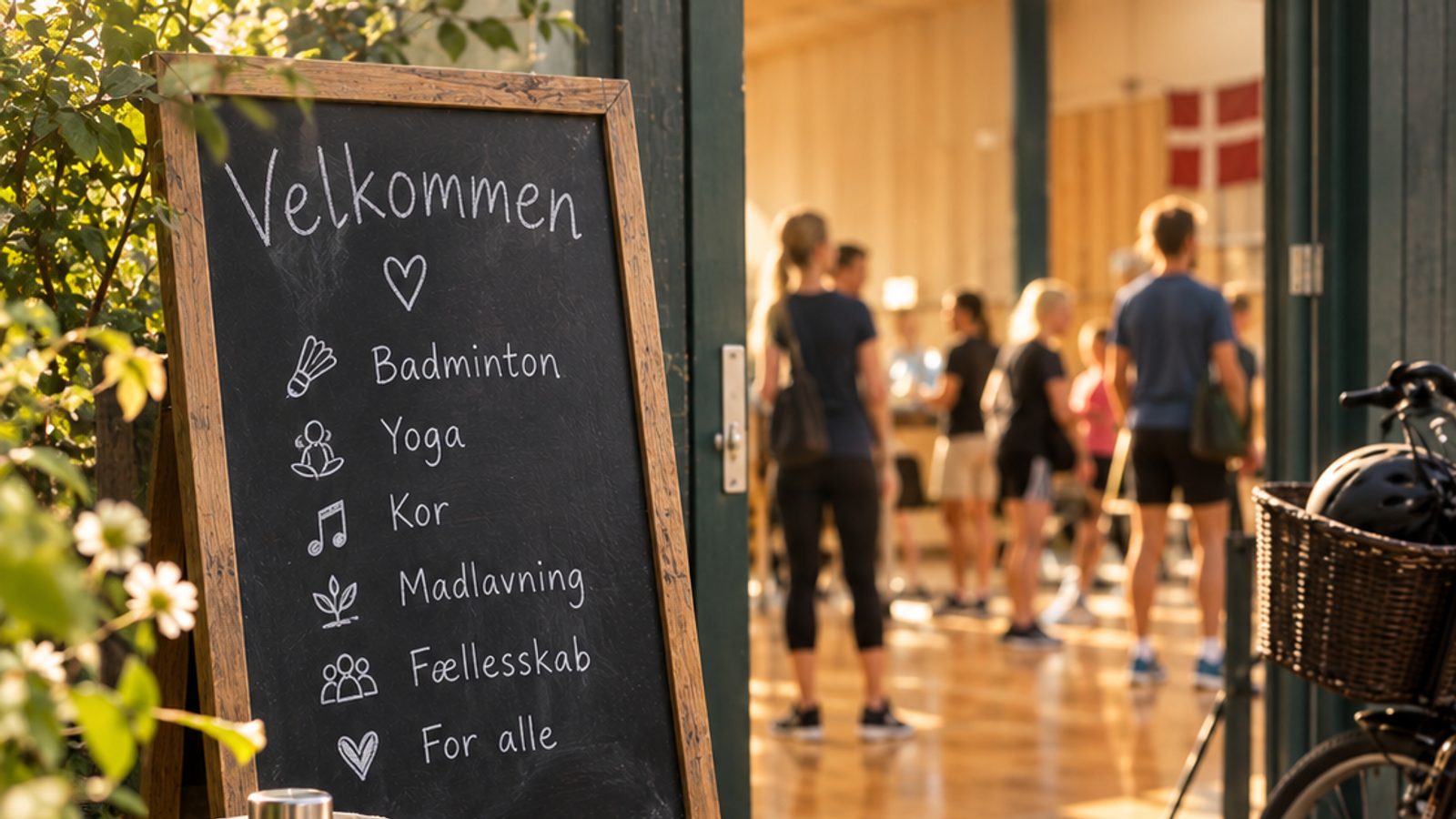
Danes grow up joining things. Football, handball, badminton, gymnastics, scouts and music. As adults, it might be running, kayaking, choir singing, embroidery, pottery, martial arts or learning the finer points of French cooking at an aftenskole.
Denmark's celebrated work-life balance isn't just about work. It is also about having a life outside it.
And that matters when you are trying to establish a social life here.
Because perhaps instead of looking for friends, you should initially be looking for repetition.
Join something and suddenly you have a reason to meet the same people every Tuesday.
Even better, you have something to talk about.
Initially, your plans have an agenda.
Badminton. Embroidery. Karate. French cooking.
But familiarity becomes conversation, and conversation can become connection.
Perhaps eventually the activity is no longer the only reason you meet.
And that might be how you get from plans with an agenda to plans without one.
But what about children?
For parents there is an obvious objection:
That sounds lovely, but when exactly am I supposed to do it?
Having children changes what is possible, but they don't necessarily have to prevent you from participating.
Some Danish clubs offer activities specifically designed for parents and children to participate in together.
You aren't simply taking your child to an activity and waiting for them to finish.
You join in too.
Perhaps it is primarily your child's interest. That's fine. The children already share something, and so do the adults: you are parents actively doing something alongside children who enjoy the same thing.
You learn together, laugh together and meet the same families again the following week.
Once again, there is that crucial ingredient:
repetition.
Instead of trying to manufacture a social life in whatever time remains after family life, family life itself can become one of the routes into your local community.
![On the board: “Welcome. Badminton. Yoga. Choir. Cooking. Community. For everyone.” [Image created with AI].](https://cdn.sanity.io/images/itcj3ig4/production/f6963bad804cb2bcf92767b441e2dafaee58a2f8-1122x1402.png?w=1400&auto=format)
And what if I don't speak Danish?
Don't let that stop you either.
Perfect Danish is by no means a prerequisite for joining Danish foreningsliv. Most Danes you encounter will be perfectly able to communicate in understandable English, so there is no need to wait until your Danish reaches a certain level before taking part.
Start in English.
If you are curious about Danish and want to use it, let the language develop alongside the relationships.
A hej becomes a short exchange. Familiar phrases begin to make sense in context. Parts of a conversation might gradually move into Danish while other parts remain in English.
There doesn't have to be an official moment when you “switch”.
And foreningsliv provides something a classroom cannot entirely recreate: a natural reason to communicate with the same people about something you already have in common.
Try some Danish. Listen. Ask.
And when Danish fails you, use English and keep talking.
In the beginning, what matters most isn't which language you are speaking.
It is that you are part of the conversation.
So, find your thing
International communities can be invaluable when you arrive in Denmark, and there is enormous comfort in meeting people who understand what it feels like to be new.
But don't stop there.
Look locally too.
Find the badminton club, the choir, the swimming class, the martial arts club, the aftenskole, the volunteer group or something completely different.
Choose something you are genuinely interested in. Or something your child is interested in that you can do together.
And then show up.
Joining something isn't a friendship vending machine. You cannot insert one badminton membership and receive three Danish friends.
Remember that long waiting list.
Give people time to recognise you. Give yourself time to become familiar. Don't wait until your Danish is perfect, until you somehow have more time or until you already feel that you belong.
Start with an agenda.
Then show up again.
And again.
Perhaps one day, someone suggests a coffee.
And perhaps, somewhere along the way, you'll find someone you can make plans with when there is no agenda at all.
Sometimes the way into your new community isn't another international event or networking opportunity.
Sometimes it is through the door of the slightly draughty local sports hall on a rainy Tuesday evening.
And perhaps that is where Denmark starts feeling a little more like home.
A Simply Settled thought
The paperwork, the home, the CPR number and the first day of school help you settle in.
Belonging is different.
It begins when you step through an open door.
It grows through familiar faces, shared interests, repeated encounters and the gradual feeling that you are no longer simply navigating somebody else's country.
You are building a life of your own in it.
When the anchor thrives, the relocation succeeds.